

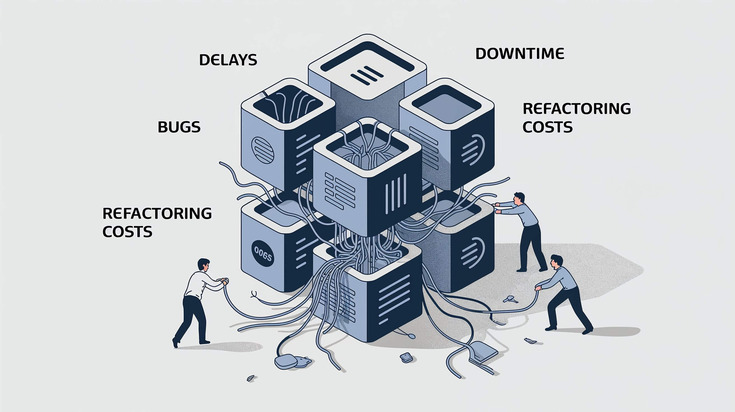
How Poor System Architecture Slowly Breaks Growing Businesses From Inside
Most business systems do not collapse in a dramatic or visible manner. They do not suddenly stop working or fail overnight. Instead, they degrade slowly, almost invisibly, as the organization around them grows faster than the structure that supports them. What begins as a simple technical foundation built to solve immediate problems gradually becomes a fragile backbone that struggles to carry the weight of increasing operational complexity.
In the early stages of a business, system design decisions are often made under pressure, focusing on speed rather than structure. The priority is to launch quickly, automate basic workflows, and reduce manual dependency. At this stage, architectural shortcuts rarely appear problematic because the scale is small and the operational load is limited. However, these early design compromises do not disappear with time; they accumulate silently within the system.
As the business expands, these hidden structural weaknesses begin to surface. What once felt like a flexible and efficient system starts to reveal rigidity, inefficiency, and fragmentation. The real challenge is not that the system stops working, but that it starts working against the organization instead of with it.
The Hidden Cost of Short-Term Architecture
Short-term architectural decisions are often justified as practical trade-offs. They reduce initial development time, lower upfront cost, and allow faster deployment. However, these decisions frequently ignore long-term structural impact. Components are tightly coupled, data models are simplified beyond sustainability, and workflows are designed around immediate convenience rather than future adaptability.
Over time, these design patterns create a system that is difficult to extend without breaking existing functionality. Every new feature requires additional workarounds, every integration introduces new complexity, and every change increases the risk of unintended side effects. The system becomes less like a structured architecture and more like a collection of interconnected patches.

A system built for speed eventually pays the cost in structural complexity.
When Growth Exposes Structural Weakness
Growth does not create problems; it exposes them. As user base increases, data volume expands, and workflows become more complex, underlying architectural flaws begin to surface. Processes that once completed instantly start to experience delays. Simple operations require multiple dependencies, and system behavior becomes harder to predict.
At this stage, engineering teams often spend more time maintaining existing functionality than building new capabilities. Instead of innovation, the focus shifts to stabilization. Instead of improvement, the priority becomes preventing breakdowns. The system begins to consume more effort than it contributes in value.
Fragmentation Through Invisible Dependencies
One of the most damaging effects of poor architecture is the creation of invisible dependencies. These are relationships between system components that are not clearly documented or intentionally designed but emerge over time due to repeated modifications and quick fixes. A change in one module unexpectedly affects another, creating a chain reaction that is difficult to trace.
This hidden interdependence makes the system fragile. Developers become cautious about making changes, fearing unintended consequences. As a result, innovation slows down, and even minor updates require extensive testing and coordination. The system becomes technically operational but strategically restrictive.
Why Architecture Determines Business Velocity
Business velocity is not only determined by team size or resources but also by the quality of the underlying system architecture. A well-structured system allows teams to move quickly because it reduces uncertainty, isolates changes, and supports predictable behavior. Poor architecture does the opposite by increasing friction at every level of development and operations.
When architecture is strong, adding new features is linear and controlled. When it is weak, every change becomes exponential in complexity. This is why two companies with similar talent and resources can experience completely different growth trajectories based solely on their system design maturity.
Conclusion
System architecture is not a static technical decision; it is a long-term business foundation. The effects of early design choices do not appear immediately but accumulate gradually as the organization scales. Over time, these choices define whether a business can evolve smoothly or becomes constrained by its own infrastructure.
The difference between scalable and fragile systems is not visible at the beginning of development. It becomes clear only when growth begins to stress the boundaries of the original design. At that point, architecture is no longer just a technical layer—it becomes a direct determinant of how far and how fast the business can move.
Leave a Reply